Gas Filter Separator

HORIZONTAL COALESCING SEPARATOR
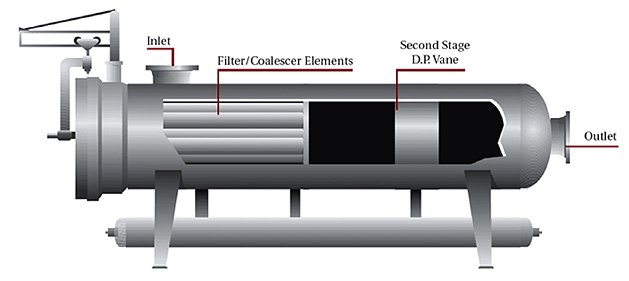
The double barrel configuration allows you to maximize the gas flow in the upper barrel without re-entrainment while the liquid drops into the lower barrel. SPEC offers standard coalescing filters that can be replaced periodically or designs that can be cleaned and reused.

Benefits
- High gas capacity with a compact vessel
- Low maintenance
- No plugging of the DP Vane
- High efficiency
- Debottle neck existing equipment

Applications
- Gas Plants
- Transmission Stations
- Gas Inlet to Chemical & Petrochemical Plants
- Gas Gathering Systems
- Turbine Fuel Gas
MECHANICAL FEATURES
ASME Pressure Vessel Code, Section VIII, Division 1 and stamped with ASME “U” symbol.
Element Support Plate and bottom drains completely drain the vessel for inspection, cleaning, and element change outs.
Designed with quick open closure for easy access to change filter elements.
Standard Design pressure, 1440.
Design temperatures are -20°F to 130°F for stock vessels.
EXPERT DESIGN, SERVICE & SUPPORT:
You can always count on SPEC for an experienced and professional recommendation. SPEC has experts who can assist in the proper sizing of coalescing and filtration products for your application. Contact SPEC for your Horizontal Coalescing
THE HORIZONTAL COALESCING SEPARATOR PROVIDES EFFECTIVE COALESCING OF AEROSOLS STREAMS WHEN PLACED IN FRONT OF:
Compressors to remove water/oil mist and dust which could cause damage to the valves and cylinders. Desiccant dehydrators to prevent lube oil mist or other liquid contaminant from entering the absorbent bed causing degradation loss or effectiveness of the desiccant or treating media. Glycol dehydrators to remove compressor lube oil mist, from the gas stream, to prevent contamination or foaming of the glycol fluid.
THE HORIZONTAL COALESCING SEPARATOR PROVIDES EFFECTIVE COALESCING OF AEROSOLS STREAMS WHEN PLACED AFTER:
Compressors to remove lubricating oil mist in the discharge stream
Contactors to remove glycol or amine carryover downstream
VERTICAL COALESCING SEPARATOR
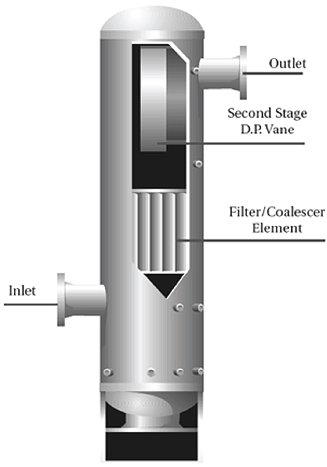
The removal of entrained liquid aerosols, such ascompressor lube oils, trace hydrocarbons, and water mist, from natural gas streams is necessary for the protection of downstream equipment. Efficient removal of these contaminants, by use of an effective coalescing separator and media combination can prevent costly problems and downtime with downstream equipment, such as compressors, membranes, instrument valves, piping, etc.
FEATURES OF A VERTICAL CONFIGURATION:
- Utilizes gravity to remove liquid.
- Only the lower portion of the element is saturated with liquid.
- Ability to allow more flow-through in a given house size.
- Ability to down-size expensive hardware and maintain flow rates.
MECHANICAL FEATURES:
- ASME Pressure Vessel Code, Section VIII, Division 1 and stamped with ASME “U” symbol.
- Element Support Plate and bottom drains completely drain the vessel for inspection, cleaning, and element change outs.
- Designed with quick open closure for easy access to change filter elements.
- Standard Design pressure, 1440.
- Design temperatures are -20°F to 130°F for stock vessels.
EXPERT DESIGN, SERVICE & SUPPORT
You can always count on SPEC for an experienced and professional recommendation. SPEC has experts who can assist in the proper sizing of coalescing and filtration products for your application. Contact SPEC for your Vertical Coalescing Separator needs.
THE VERTICAL COALESCING SEPARATOR PROVIDES EFFECTIVE COALESCING OF AEROSOLS STREAMS WHEN PLACED IN FRONT OF:
Compressors to remove water/oil mist and dust which could cause damage to the valves and cylinders.
Desiccant dehydrators to prevent lube oil mist or other liquid contaminant from entering the absorbent bed causing degradation loss or effectiveness of the desiccant or treating media.
Glycol dehydrators to remove compressor lube oil mist, from the gas stream, to prevent contamination or foaming of the glycol fluid.
THE VERTICAL COALESCING SEPARATOR PROVIDES EFFECTIVE COALESCING OF AEROSOLS STREAMS WHEN PLACED AFTER:
Compressors to remove lubricating oil mist in the discharge stream
Contactors to remove glycol or amine carryover downstream